- All
- Product Name
- Product Keyword
- Product Model
- Product Summary
- Product Description
- Multi Field Search

Views: 0 Author: Site Editor Publish Time: 2026-11-01 Origin: Site
Modern global communication relies heavily on light. Picture a massive hyperscale data center humming with servers. The true lifeline connecting them is not copper wire. It is microscopic pulses of light. Fiber optics carry this massive information globally, bridging continents in mere milliseconds.
However, the technology generating these pulses remains a mystery to many outside the telecom industry. We often overlook the optical transmitter, which acts as the true beating heart of the network. In this post, we will demystify this critical active device. We will explore its core components and provide actionable insights on how to choose the right model for your physical infrastructure.
At the starting point of every fiber optic link, you will find an optical transmitting module. This active hardware acts as the vital bridge between the digital world and the physical layer of fiber. It translates electronic data, represented as simple zeros and ones, into precise optical light pulses. Unlike passive network components like patch cords or optical splitters, it requires a dedicated external power source to function.
Think of it as the speaker of the network. It continuously converts electrical voltages into optical signals that travel across vast distances. Historically, these units have evolved significantly. Early versions were bulky, low-speed modules using basic Light Emitting Diodes. Today, relentless bandwidth demand is pushing transmitter technology toward unprecedented speeds. Modern devices can now transmit massive amounts of data at terabit speeds. They are rapidly moving away from discrete components to drastically reduce power consumption and physical footprint.
Looking at current industry trajectories, the landscape of optical communication is undergoing a massive transformation. The surge in artificial intelligence training, 5G rollouts, and edge computing creates an insatiable demand for higher bandwidth and lower latency. Network architects are moving away from traditional architectures. We are witnessing a massive industry shift toward highly integrated silicon photonics and 400G to 800G capable modules in core networks.
Specifically, the access network segment is experiencing a renaissance. As hybrid fiber-coaxial networks upgrade to DOCSIS 4.0 and beyond, operators demand highly linear, cost-effective solutions. The market shows a strong preference for equipment that balances premium performance with strict budget constraints. High-performance direct-modulated lasers are stepping up to fill this gap. They provide operators with the necessary output power to push deeper into residential neighborhoods without the exorbitant costs associated with external modulation. This trend highlights a pragmatic approach in modern network engineering: maximizing existing fiber assets while keeping capital expenditure strictly under control.
The signal conversion process follows a highly orchestrated sequence. Initially, a raw electrical radio frequency signal enters the equipment. Internal drive circuitry then conditions this feed for optimal performance. Subsequently, the refined electrical signal modulates the light source. Finally, the resulting light is precisely coupled into the microscopic core of the optical fiber for transport.
To visualize this mechanism, imagine a high-tech flashlight flickering on and off millions of times every single second. This rapid, flawless Morse code of light is precisely what carries your high-definition video streams and cloud data through the glass pipe. The faster and cleaner the flicker, the higher the bandwidth capacity of the link. In our daily field operations, we rely on advanced Automatic Gain Control circuits to ensure this input RF signal remains perfectly stable. Without stable RF input, the optical output will inevitably suffer from severe distortion.
Understanding the internal anatomy of this equipment is essential for troubleshooting and network design. The flawless synergy of several microscopic parts ensures seamless data flow.
The light source serves as the most critical element of any transmitting module. Network engineers generally choose between two distinct technologies based on application requirements. Light Emitting Diodes are cost-effective options that work best for short-distance transmissions over multimode fiber. In contrast, Laser Diodes are the standard for high-performance networks. They offer higher precision, greater power, and narrower spectral emission.
For medium to long-range applications, Distributed Feedback lasers are strictly preferred due to their stable, narrow wavelength. Fabry-Perot lasers serve as cost-effective solutions for shorter, medium-range links.
The modulator functions as the gatekeeper of the data stream. It takes the steady light beam generated by the laser and encodes it with your information. It achieves this by rapidly altering the intensity, phase, or polarization of the light wave. Without this specific component, the laser would simply shine a constant, unvarying beam. It would carry absolutely no usable data to the receiving end.
If the laser is the heart of the device, the drive circuit is undoubtedly its brain. It supplies the exact electrical current required to turn the laser on and off reliably. Furthermore, high-quality models feature advanced RF pre-distortion circuits. By anticipating and correcting non-linear distortion inherent in direct modulation, these circuits significantly improve carrier-to-noise ratio and composite second-order metrics. This ensures crystal-clear signal delivery across the entire node.
When dealing with fluctuating ambient temperatures in an outdoor telecommunications cabinet, lasers become notoriously sensitive. Even minor heat variations can cause wavelength drift or power instability. To combat this physical limitation, manufacturers integrate a Thermo-Electric Cooler. This active cooling mechanism keeps the semiconductor environment perfectly stable. Consequently, it ensures consistent, error-free communication regardless of blistering summers or freezing winters.
Choosing the appropriate modulation method remains a pivotal decision for any network architect. This choice directly impacts both capital expenditure and link performance.
In direct modulation architecture, the drive current applied to the laser fluctuates directly. This turns the light on and off in tandem with the data stream. It represents a highly cost-effective, space-saving design. While perfectly suited for many regional applications, this method can suffer from wavelength dispersion over extreme distances. For instance, deploying a high-quality 1550nm optical transmitter utilizing direct modulation is an absolute staple in local CATV networks. It brilliantly balances operational performance with strict budget constraints.
Conversely, external modulation employs a laser that emits a continuous, steady beam of light. A separate device acts much like a high-speed mechanical shutter to encode the data onto this beam. This configuration produces an exceptionally clean signal with minimal dispersion. Consequently, it serves as the gold standard for ultra-long-haul networks. However, this premium performance comes accompanied by a significantly higher price tag and increased architectural complexity.
To make the decision clearer for frontline deployment, here is a core comparison between the two technologies:
Feature | Direct Modulation | External Modulation |
|---|---|---|
Operating Principle | Laser current is directly varied by the RF signal. | Laser emits continuous light; external modulator shapes the signal. |
Signal Dispersion | Higher dispersion over very long distances. | Extremely low dispersion, ideal for ultra-long haul. |
Cost & Footprint | Highly cost-effective, compact 1RU rack designs. | High capital expenditure, complex internal architecture. |
Best Application | Local CATV, FTTH distribution, medium-haul links up to 30 kilometers. | Core DWDM networks, ultra-high-speed 100G+ links over 100 kilometers. |
When engineering a fiber optic network, procurement decisions must be driven by empirical data. A transmitting module is never a one-size-fits-all component. Its specifications dictate the overall capacity, reach, and reliability of the communication link. Professionals must rigorously evaluate several core metrics before integration.
The operating wavelength indicates the specific color of infrared light emitted. The fiber optic industry relies primarily on standard transmission windows. For medium to long-haul applications, 1550nm is the absolute gold standard. Standard silica glass exhibits its lowest attenuation rate at this specific wavelength.
Output optical power refers to the strength of the light signal injected into the fiber optic cable. This metric is a critical factor in calculating the optical link budget. If the launch power is too low, the signal will degrade into the noise floor before reaching the receiver. High-grade direct-modulated units typically offer selectable output powers ranging from 2mW to 10mW. This flexibility allows field engineers to precisely match the power level to the specific node distance, preventing both signal loss and non-linear distortion.
In analog and hybrid networks, digital metrics like Bit Error Rate only tell half the story. Frontline engineers must pay close attention to Carrier-to-Noise Ratio, Composite Second Order, and Composite Triple Beat. A premium optical transmitting device will feature advanced pre-distortion circuitry to keep CSO and CTB exceptionally low. This guarantees that end-users receive crystal clear video and uninterrupted broadband data.
Signal input levels from headend equipment can fluctuate. Therefore, having robust Automatic Gain Control and Manual Gain Control is non-negotiable. These features ensure the laser receives a perfectly leveled RF signal, eliminating the risk of over-modulation or under-modulation during daily operations.
The versatility of these devices has made them foundational building blocks for modern industries. Their specific application dictates the laser technology and packaging utilized.
The Cable Television industry relies heavily on Hybrid Fiber-Coaxial networks to deliver high-definition video and broadband internet. Transmitting complex analog and digital RF signals requires highly linear optical devices. A prime solution for this architecture is the 1550nm direct-modulated transmitter. It provides the necessary output power to distribute signals across extensive regional nodes without the premium cost associated with external modulation.
FTTH networks bring high-speed optical connections directly to residential premises. At the core of the provider central office, robust transmitting modules efficiently broadcast downstream data to dozens of splitters and end-user modems. These environments demand highly reliable output power and dual redundant power supplies to guarantee zero downtime.
Modern data centers require massive internal bandwidth to support real-time data processing. Here, the focus shifts to high-density, low-power consumption, and short-reach interconnectivity. Transmitters utilizing VCSEL technology operating at 850nm over multimode fiber are ubiquitous in these settings.
Selecting the appropriate equipment requires a systematic analysis of your physical infrastructure and budgetary constraints. A mismatch in specifications leads to network downtime and wasted capital. Do not rely on abstract theories. Follow these actionable, frontline standards.
The first fundamental step is calculating your total optical loss. Factor in fiber distance, splice losses, and splitter ratios. If your link loss is relatively low, a 2mW to 4mW output might suffice. For deeper fiber penetration across neighborhoods, you will need a robust 10mW output. Over-powering a short link will blind the receiver, while under-powering it causes complete signal dropout.
Network architects must weigh link distances against financial constraints. This often boils down to choosing between direct and external modulation. For short to medium distances, deploying a direct-modulated optical transmitter is highly effective. It simplifies internal circuitry, reduces the physical footprint, and significantly lowers equipment costs. You save capital without sacrificing the video or data quality delivered to the subscriber.
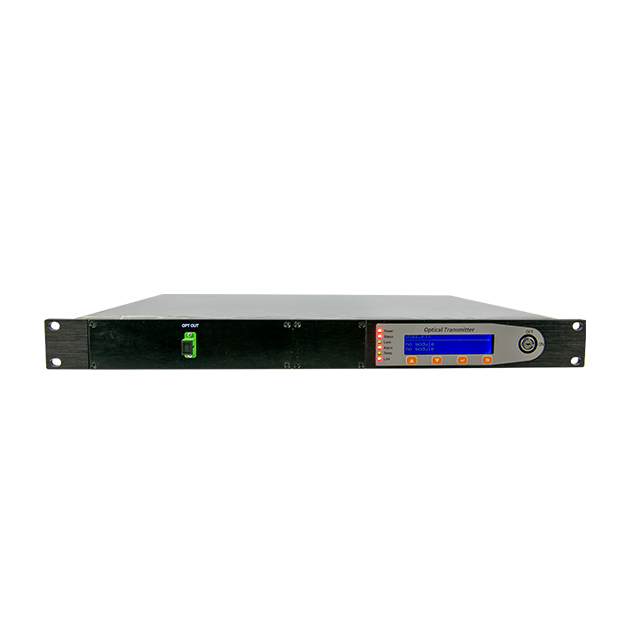
Never compromise on hardware reliability. When evaluating a unit, ensure it features dual hot-swappable power supplies. In a live headend environment, a single power supply failure should never take down an entire neighborhood internet connection. Furthermore, look for intelligent microprocessors that monitor laser temperature and output power in real-time, complete with accessible front-panel displays for quick field diagnostics.
Ultimately, an optical transmitter stands as a marvel of modern engineering. Light sources, modulators, and drive circuits must work together seamlessly to ensure data integrity across the globe. Choosing the right device is foundational for your infrastructure. It helps you build a reliable, high-speed, and future-proof network.
Are you upgrading your current HFC network or expanding your FTTH footprint? Choosing equipment that balances carrier-grade reliability with cost-efficiency is critical. By carefully evaluating your specific link distances and optical budgets, you can deploy the perfect solution. We highly recommend exploring the high-performance catalog at Zhiyi. Their engineered solutions, including advanced 1550nm direct-modulated modules, are designed to optimize your fiber optic systems and maximize your network true potential.
An optical transmitter acts as the starting point of a fiber optic link. It accepts an electrical signal from a network switch and converts it into precise pulses of light to send data down the fiber. An optical receiver performs the exact opposite function at the destination. It uses a highly sensitive photodetector to catch the incoming light pulses and convert them back into an electrical signal.
No, they are not exactly the same, though they are closely related. A transmitter is a standalone functional unit dedicated solely to sending light. A transceiver is a single, integrated module that houses both a transmitter and a receiver within the same casing. This dual configuration allows bidirectional communication over a network link.
While LEDs are cheaper and suitable for short links, lasers are strictly preferred for modern, high-capacity networks. Lasers produce a highly focused, coherent beam of light with a very narrow spectral width. This means the light travels in a tighter path with less spreading over distance, allowing data transmission at vastly higher speeds.
When operated within their specified environmental parameters, high-quality units are incredibly reliable. With proper thermal management facilitated by internal Thermo-Electric Coolers, a unit can reliably operate for 5 to 10 years, or even longer. In practical industry scenarios, these devices are usually retired due to network speed upgrades rather than physical component failure.
The term 1550nm refers to the specific wavelength, measured in nanometers, of the infrared light emitted by the laser. This wavelength is highly favored in telecommunications and CATV networks. Standard silica glass optical fiber exhibits its absolute lowest level of signal attenuation when carrying light at 1550nm, allowing the signal to travel much further distances.
Low output power usually stems from three common culprits. First, inspect the fiber optic connector interface. A dirty or scratched APC connector will drastically reduce launched power. Second, verify the RF input level. If the driving RF signal is too low, the laser cannot achieve full modulation depth. Finally, check the front panel diagnostics for laser aging alarms. If the bias current has spiked abnormally, the laser diode itself may be nearing the end of its lifecycle.
Chirping occurs because rapidly changing the electrical drive current to turn the laser on and off also causes microscopic fluctuations in the semiconductor refractive index. This physical reaction briefly shifts the emitted wavelength. As these slightly different wavelengths travel down a long fiber, they move at different speeds, causing the optical pulse to spread out and distort. This is why external modulation is preferred for ultra-long-haul links, while direct modulation remains the king of cost-effective regional distribution.