
Views: 0 Author: Site Editor Publish Time: 2025-10-23 Origin: Site
In today's digital world, fast communication is essential. Optical transmitters are key to achieving high-speed, long-distance data transmission with minimal loss. These devices convert electrical signals into optical signals, playing a vital role in modern communication systems.
In this article, we will explore the importance of optical transmitters, their components, how they work, and their wide applications. You will also learn how to select the right optical transmitter for your business needs.
An optical transmitter is a device designed to convert electrical signals into optical signals (light). It plays a crucial role in fiber optic communication, which relies on the transmission of light through optical fibers. These transmitters are widely used in various industries, including telecommunications, data centers, and medical technologies, to enable high-speed data transmission over long distances. The primary purpose of an optical transmitter is to provide a seamless means of transferring information by converting electrical signals from devices such as computers or switches into light signals that can be transmitted efficiently through optical fibers.
An optical transmitter comprises several key components that work together to achieve the conversion from electrical to optical signals. These include:
● Light Source: The light source is responsible for emitting the light signal. Common light sources used in optical transmitters are laser diodes and light-emitting diodes (LEDs). The type of light source affects the efficiency, modulation bandwidth, and transmission distance.
● Modulator and Driver Circuits: The modulator adjusts the intensity, frequency, or phase of the light source to encode the data onto the light wave. Driver circuits control the electrical signals fed into the modulator or light source, ensuring the right power levels for modulation.
● Optical Interface and Coupling Mechanisms: The optical interface connects the light source to the optical fiber, ensuring minimal loss in the optical signal during transmission. These mechanisms ensure that the light from the source is efficiently coupled into the fiber optic cable.
Light Source Type | Wavelength Range | Common Applications | Advantages |
LED | 850 nm, 1300 nm | Short-distance transmission | Low cost, simple design |
DFB Laser | 1550 nm | Long-distance telecom | High wavelength stability, low loss |
VCSEL | 850 nm | Data centers, short-range | Compact, high-speed performance |
The working principle of an optical transmitter involves the conversion of electrical signals into modulated light signals. Here's a breakdown of the process:
1. Signal Conversion: The transmitter first receives an electrical signal, typically from a computer or communication device.
2. Light Emission: The light source, such as a laser diode or LED, emits light in response to the electrical input.
3. Modulation: The modulator encodes the electrical data onto the light wave by adjusting its intensity, frequency, or phase.
4. Transmission: The light signal is then directed into an optical fiber for transmission.
Once the optical signal reaches the receiving end, a photodetector converts it back into an electrical signal, completing the communication cycle.
Continuous-Wave (CW) optical transmitters emit a constant, uninterrupted light signal. These are ideal for long-distance, high-speed communication because they can maintain a steady transmission without the need for frequent adjustments. CW optical transmitters are commonly used in telecommunication networks and long-haul fiber-optic systems.
Pulse-modulated optical transmitters emit light in pulses rather than a continuous stream. This type of transmitter is widely used in digital communication systems, especially where data is transmitted in binary form (0s and 1s). Pulse modulation is effective in applications that require precise timing and synchronization, such as in computer networking and short-range communication systems.
Wavelength Division Multiplexing (WDM) transmitters are a crucial component in modern fiber-optic networks. They work by transmitting multiple signals at different wavelengths (or "colors") of light through the same optical fiber. This technique significantly increases the capacity of the fiber network, allowing for more data to be transmitted simultaneously. WDM transmitters are typically used in high-traffic telecommunications systems and large data centers.
Light sources are at the heart of every optical transmitter. The most common types of light sources used in optical transmitters include:
● Light Emitting Diodes (LEDs): Simple and cost-effective, LEDs are often used in short-distance optical communication. However, they have limited bandwidth and lower output power compared to lasers.
● Distributed Feedback (DFB) Lasers: These lasers offer high wavelength stability and are ideal for long-distance transmission. DFB lasers are commonly used in telecom systems, where stability and precision are critical.
● Vertical Cavity Surface-Emitting Lasers (VCSELs): Known for their small form factor, VCSELs are widely used in high-speed data transfer applications like data centers, where space and efficiency are paramount.
● Fabry-Perot (FP) Lasers: FP lasers are often used in short- to medium-distance applications due to their cost-effectiveness and moderate power output.
The modulation technique used in an optical transmitter determines how data is encoded onto the light signal. There are two primary modulation methods:
● Direct Modulation: This method involves varying the drive current of the light source (e.g., a laser diode) to encode the data directly onto the light signal. It is simple and cost-effective but can introduce signal distortion at high transmission speeds.
● External Modulation: External modulators, such as Mach-Zehnder modulators (MZMs), are used to modulate the light signal separately from the light source. This technique provides better signal integrity, especially at high speeds, and is often used in long-haul or high-performance optical networks.
Driver circuits are essential for controlling the light source and modulator. These circuits ensure that the light source operates at the correct power levels for modulation and that the data is properly encoded onto the light signal. Additionally, encoding logic ensures that the transmitted data is correctly formatted, reducing errors and improving the overall reliability of the transmission.
The process begins with the generation of an electrical signal, typically from a communication device. This electrical signal is fed into the optical transmitter, where it is converted into a light signal. The light signal is then modulated to carry the encoded data. This modulation may involve varying the intensity, frequency, or phase of the light, depending on the type of modulation used.
Once the light signal is modulated, it is directed into an optical fiber. The optical fiber serves as the transmission medium, guiding the light signal with minimal loss due to its core and cladding structure. The light signal remains confined within the core of the fiber, allowing it to travel long distances without significant degradation.
Over long distances, the light signal may weaken due to attenuation (signal loss). To combat this, optical amplifiers are used to boost the signal at regular intervals. In some cases, signal regeneration may be necessary to reshape and amplify the signal, ensuring that it remains strong and accurate by the time it reaches its destination.
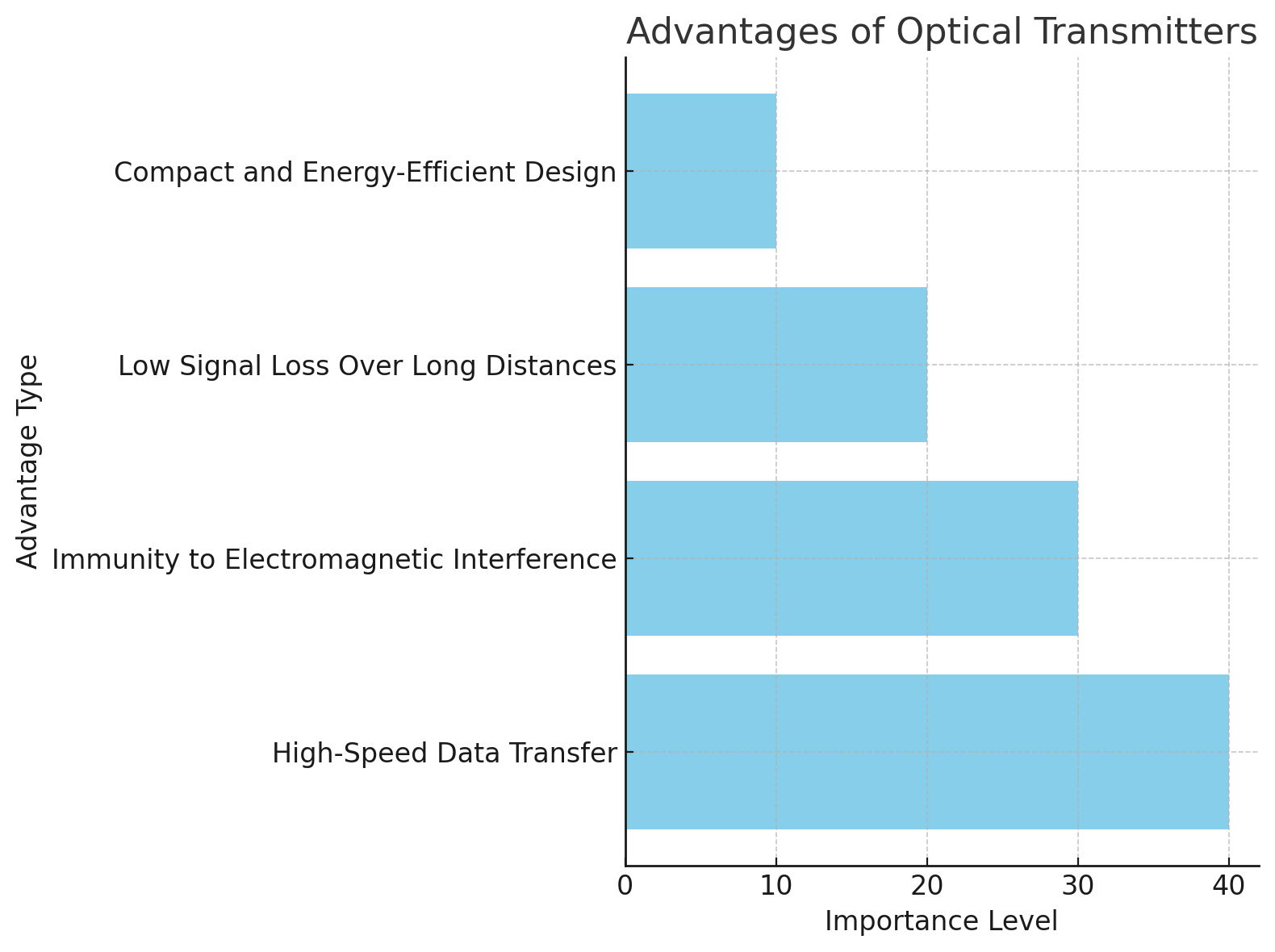
Optical transmitters are capable of enabling high-speed data transmission, which is essential for modern communication networks. Fiber-optic cables, used in conjunction with optical transmitters, can carry vast amounts of data at speeds that surpass traditional copper cables. This capability is crucial for services like streaming, cloud computing, and high-bandwidth telecommunications.
Unlike electrical systems, optical transmitters are immune to electromagnetic interference (EMI). This makes them highly reliable in environments where electrical noise could otherwise disrupt data transmission, such as in industrial settings or near power lines.
One of the key advantages of optical transmission is its ability to maintain signal integrity over long distances. Unlike electrical signals, which degrade over distance, optical signals experience very low attenuation. This makes optical transmitters ideal for long-haul communication, where maintaining a strong signal is critical.
Optical transmitters are typically compact and energy-efficient, making them suitable for a wide range of applications. They consume less power compared to traditional electrical transmitters and can be easily integrated into various devices, from data centers to sensors.
Advantage | Description |
High-Speed Data Transfer | Enables faster communication, essential for broadband and 5G networks. |
Immunity to Electromagnetic Interference | Ideal for environments with electrical noise, such as factories or near power lines. |
Low Signal Loss Over Long Distances | Ensures minimal signal degradation in long-haul fiber-optic networks. |
Compact and Energy-Efficient Design | Small form factor and low power consumption for easier installation. |
Optical transmitters are essential for enabling broadband communication and the rollout of 5G networks. They are used to transmit data over fiber-optic networks, ensuring fast and reliable communication for both urban and rural areas. Optical transmitters support everything from telephone systems to internet services.
In data centers, optical transmitters link servers, storage devices, and other critical components. They enable the high-speed transfer of data between servers and provide the necessary bandwidth for cloud computing, video streaming, and other data-intensive applications.
Optical transmitters are also used in medical imaging devices, such as endoscopes and optical coherence tomography (OCT) systems, to transmit high-resolution data. They are essential in real-time diagnostic applications, where precise and immediate data transmission is crucial.
In industrial control systems and aerospace applications, optical transmitters offer a reliable and interference-free means of transmitting data. These systems often require high levels of precision and are used in environments where electromagnetic interference could be a significant issue.
Choosing the right optical transmitter depends on the specific requirements of the application. For long-distance communication, CW transmitters are ideal, while pulse-modulated transmitters are better for short-range systems. WDM transmitters are suitable for high-capacity networks.
It's essential to ensure that the optical transmitter can support the required data rate and modulation format for the application. High-speed data applications, such as 400G networks, require transmitters that can handle high modulation rates and bandwidth.
When selecting an optical transmitter, it's important to ensure compatibility with other components in the system. Transmitters should be able to integrate seamlessly with optical fibers, receivers, and amplifiers to ensure reliable performance.
Consider both budget and performance requirements when selecting an optical transmitter. High-performance transmitters may come with a higher price tag, but they offer improved signal quality and longer transmission distances, which may justify the investment.
Optical transmitters are essential in modern communication systems. They enable high-speed, long-distance data transmission with minimal signal loss. These devices play a vital role in fiber optic networks, data centers, and telecommunications. Understanding their function, components, and applications helps businesses select the right optical transmitters. This ensures efficient and reliable communication systems. Companies like ZHIYI offer high-quality optical transmitters, providing solutions that enhance network performance and meet specific business needs.
A: An Optical Transmitter is a device that converts electrical signals into optical signals for high-speed, long-distance data transmission, typically used in fiber optic communication systems.
A: An Optical Transmitter works by emitting light from a light source, such as a laser or LED, which is modulated to carry data signals through optical fibers.
A: Optical Transmitters enable efficient, high-speed communication over long distances with minimal signal loss, essential in telecommunications, data centers, and broadband networks.
A: Optical Transmitters provide high-speed data transfer, immunity to electromagnetic interference, and low signal loss, making them ideal for long-haul communication and data networking.
A: Choose an Optical Transmitter based on data rate, modulation type, transmission distance, and compatibility with other network components to ensure efficient performance.
A: Optical Transmitters commonly use Light Emitting Diodes (LEDs), DFB lasers, and VCSELs, each offering different performance characteristics for specific applications.


