- All
- Product Name
- Product Keyword
- Product Model
- Product Summary
- Product Description
- Multi Field Search

Views: 0 Author: Site Editor Publish Time: 2025-11-06 Origin: Site
In today’s fast-paced digital world, efficient data transmission is more crucial than ever. As data usage grows, the demand for faster, more reliable technologies has skyrocketed. Optical fiber cables, transmitting data via light signals, are leading the charge.
This article will explain how data is transmitted through optical fiber cables. We’ll focus on the key role of Optical Transmitters, the basics of fiber optics, and how they enable high-speed communication.
Optical fiber is a thin strand of glass or plastic designed to carry data as light signals. Unlike traditional electrical cables, optical fiber uses light to transmit data, which results in faster speeds and greater distances. The core of an optical fiber is made from ultra-pure glass, which allows light to travel through it with minimal loss of signal quality. Surrounding the core is a layer of cladding that reflects light back into the core, ensuring it stays confined within the fiber. Finally, the outer protective coating ensures that the fiber is durable and safe from environmental damage.
The core, cladding, and coating are essential components that allow optical fibers to deliver high-speed, high-capacity data transmission over long distances with minimal loss or distortion.
Component | Function |
Core | Carries the light signals for data transmission. |
Cladding | Reflects light back into the core, ensuring it stays contained. |
Coating (Buffer) | Protects the core and cladding from external damage. |
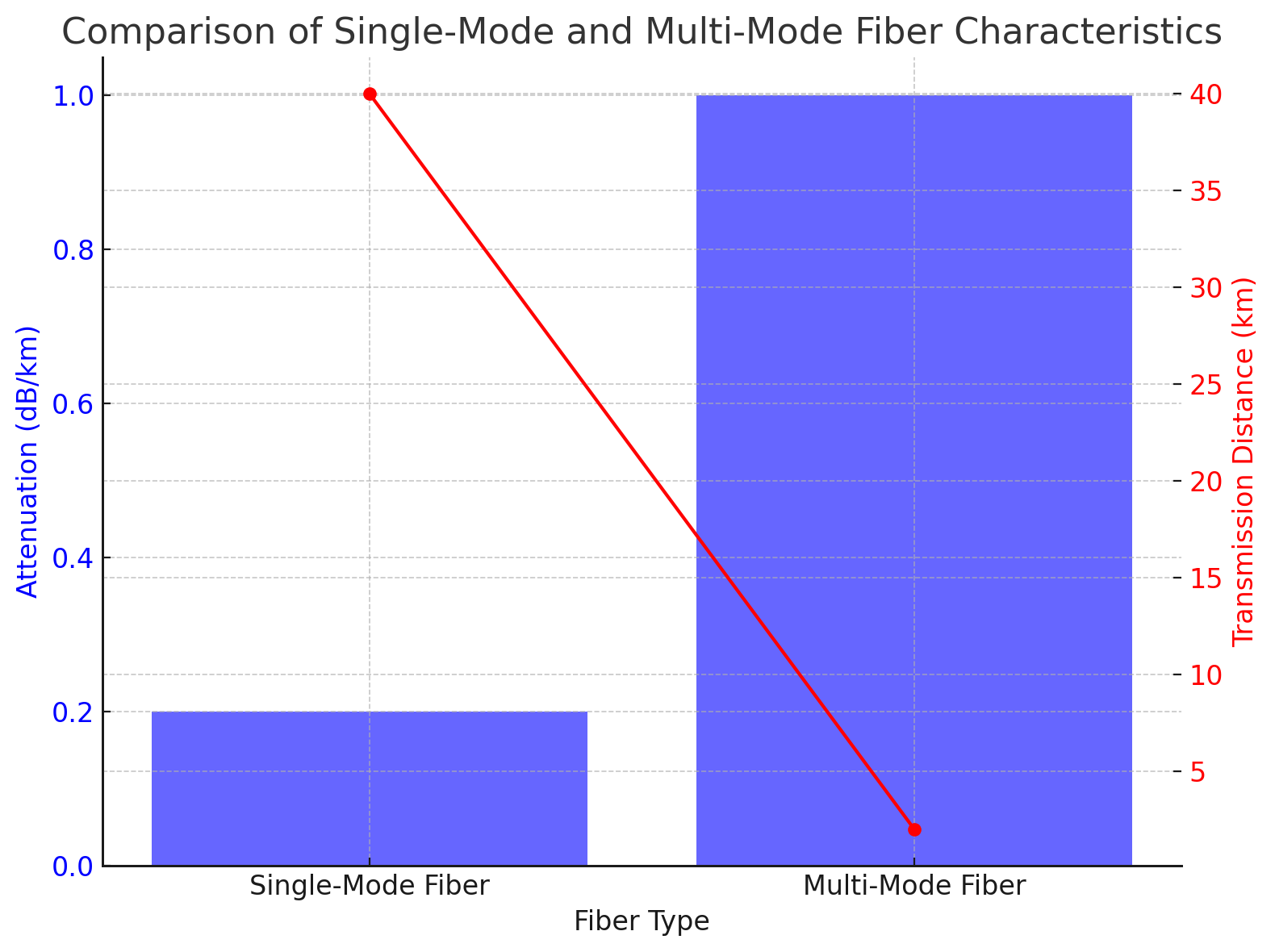
Optical fibers come in two main types: single-mode and multi-mode fibers.
● Single-Mode Fiber: This fiber has a small core, typically around 9 microns in diameter, allowing light to travel along a single path. This design reduces the potential for signal distortion, making it ideal for long-distance communication, such as in telecommunications networks or high-speed internet connections.
● Multi-Mode Fiber: Multi-mode fiber has a larger core, usually between 50 to 62.5 microns, which allows multiple light paths to travel simultaneously. Although multi-mode fiber has higher signal distortion due to multiple paths, it is more suitable for short-distance transmissions such as within buildings or across campuses.
Each type of fiber has its specific applications based on the distance and bandwidth requirements of the transmission system.
Property | Single-Mode Fiber | Multi-Mode Fiber |
Core Diameter | 9 micrometers | 50-62.5 micrometers |
Light Propagation | Carries one light mode (laser-based) | Carries multiple light modes (LED-based) |
Ideal Use | Long-distance communication (telecom, internet) | Shorter distances (LANs, data centers) |
Signal Loss | Low signal loss over long distances | Higher signal loss over shorter distances |
Bandwidth | Higher bandwidth for high-speed data transfer | Lower bandwidth, suitable for lower capacity |
Data transmission through optical fiber cables is carried out using pulses of light. The light signals represent digital data, where each pulse corresponds to a binary '1' or '0'. These light pulses are generated by an Optical Transmitter, a crucial component that converts electrical signals into light. Once generated, the light pulses travel through the fiber’s core, bouncing off the cladding due to a process called Total Internal Reflection, which keeps the light confined within the core.
The Optical Transmitter plays a key role here, as it is responsible for ensuring the correct conversion of electrical signals into light signals that maintain the integrity of the data being transmitted.
Total Internal Reflection is the key principle that enables the transmission of light through optical fibers over long distances without significant signal loss. When light reaches the boundary between the core and cladding at a certain angle, it reflects back into the core rather than escaping. This ensures that the light stays within the fiber, even when the cable is bent or twisted, allowing it to travel large distances without degradation.
For effective data transmission, this phenomenon helps to maintain the quality of the signal, which is essential for high-speed data transfer.
To transmit data effectively through optical fibers, the light pulses are modulated in various ways. Amplitude Modulation (AM), Frequency Modulation (FM), and Phase Modulation (PM) are common techniques used to encode digital data into light signals. These modulation techniques adjust the characteristics of the light waves, such as their intensity, frequency, or phase, to represent the data being transmitted.
Additionally, Wavelength Division Multiplexing (WDM) is used to further increase data capacity. WDM allows multiple wavelengths (or channels) of light to travel through the same optical fiber simultaneously, increasing the amount of data that can be transmitted at once. By utilizing different wavelengths for different data streams, WDM optimizes the fiber’s capacity, making it highly efficient for large-scale communication networks.
An Optical Transmitter is a device that converts electrical signals into optical signals for transmission over optical fibers. This is accomplished using light sources such as Light Emitting Diodes (LEDs) or Laser Diodes (LDs). These light sources emit light at specific wavelengths, which then carry the encoded data through the fiber.
The transmitter consists of several components, including the light source, a modulator that encodes data onto the light, and a coupling mechanism that directs the light into the fiber. The Optical Transmitter ensures that the data is transmitted accurately and at high speeds by generating stable and continuous light pulses.
Component | Role in Fiber Optic Communication |
Optical Transmitter | Converts electrical signals into optical signals for transmission. |
Lasers & LEDs | Generate the light signals that carry data through the fiber. |
Modulation Techniques | Encode data onto light pulses using changes in intensity or wavelength. |
Integration with Receiver | Receives the optical signals and converts them back to electrical signals. |
Once the Optical Transmitter has converted the electrical signal into light, the light pulse travels through the optical fiber until it reaches an Optical Receiver. The receiver, which is typically located at the destination, converts the light signal back into an electrical signal that can be interpreted by electronic devices. This system allows for long-distance, high-speed communication by using fiber optic cables to carry data and Optical Transmitters to initiate the transmission.
The integration of Optical Transmitters into fiber optic networks is vital for ensuring that the network can handle large volumes of data efficiently and securely. These transmitters are crucial for everything from internet connectivity to communication between data centers.
Optical fiber offers a number of advantages over traditional copper cables, making it the preferred choice for high-speed communication networks:
● High-Speed Data Transfer: The use of light to transmit data results in significantly higher speeds than copper cables.
● Long-Distance Transmission: Fiber optics can transmit data over much longer distances without significant signal loss, making them ideal for global communication systems.
● Immunity to Electromagnetic Interference (EMI): Since optical fibers transmit light instead of electrical signals, they are immune to electromagnetic interference, ensuring more reliable and stable communication.
These advantages make fiber optic technology an essential part of modern communications, from high-speed internet services to backbone infrastructure for global telecommunications.
Feature | Optical Fiber | Copper Cables |
Data Transmission | High-speed, long-distance transmission with minimal loss | Slower data transmission over shorter distances |
Bandwidth | Higher bandwidth and capacity | Lower bandwidth, limited capacity |
Immunity to Interference | Immune to electromagnetic interference (EMI) | Prone to EMI, signal degradation in noisy environments |
Durability | Resistant to corrosion and environmental factors | Prone to corrosion and damage over time |
Installation Cost | Higher initial cost, but lower long-term costs | Lower initial cost, but higher maintenance costs |
Despite the numerous advantages, fiber optic technology does have some challenges:
● Signal Attenuation: Over long distances, optical signals can weaken due to various factors such as scattering and absorption. This necessitates the use of Optical Amplifiers to boost the signal over large distances.
● Installation and Maintenance: Fiber optic cables are more fragile than copper cables, requiring careful handling during installation. Specialized skills and equipment are also necessary for splicing fibers and ensuring the network remains reliable.
However, with careful planning and ongoing advancements in fiber optic technology, these challenges can be managed effectively.
Optical fiber is the backbone of modern telecommunication and internet services. From connecting cities and countries to ensuring fast, reliable internet in homes and businesses, fiber optic cables are essential for transmitting high volumes of data at high speeds. As demand for high-speed internet continues to rise, fiber optics offer the scalability required to meet these needs.
● Medical Imaging and Endoscopy: Optical fiber is used in medical diagnostics, enabling minimally invasive procedures such as endoscopy. The ability to transmit high-quality images and data over fiber allows for real-time diagnostic results.
● Secure Communications: Fiber optics are used in military applications to ensure secure, encrypted communication that is resistant to interception and interference.
As data transmission needs grow, the capacity of fiber optic networks continues to increase. Technologies such as Wavelength Division Multiplexing (WDM) and faster Optical Transmitters are key drivers in enhancing data rates. The development of 400G and even 800G systems is enabling fiber optics to support future technologies like 5G and beyond, ensuring networks can handle the increasing volume of data.
The miniaturization of optical fiber components is making it easier to integrate fiber optics into a variety of devices, from consumer electronics to industrial IoT applications. Flexible optical fibers and microfibers are enabling new uses in fields like medical diagnostics, automotive technology, and wearable devices.
Fiber optics, along with Optical Transmitters, are at the core of modern communication systems, enabling fast, long-distance data transfer with minimal signal loss. These technologies are critical for applications like internet infrastructure, secure communications, and medical imaging. As technology advances, fiber optics will evolve to meet increasing data demands. Companies like ZHIYI offer cutting-edge Optical Transmitters, ensuring businesses are equipped with future-proof, high-performance communication infrastructure. Investing in these solutions today will prepare your business for the digital challenges of tomorrow.
A: An Optical Transmitter converts electrical signals into light signals for transmission through optical fiber cables. It plays a crucial role in enabling high-speed data transfer.
A: Data travels as light pulses in the fiber core, guided by total internal reflection. The Optical Transmitter is responsible for converting electrical data into light signals.
A: Optical Transmitters are essential for converting electrical signals into optical ones, enabling high-speed and long-distance communication over fiber optic cables.
A: Optical fiber offers higher bandwidth, longer transmission distances, and immunity to electromagnetic interference, making it superior to copper cables.
A: Single-mode and multi-mode fibers are commonly used. Single-mode fibers support long-distance transmission, while multi-mode fibers are used for shorter distances.
A: Optical Transmitters allow for efficient, high-speed data transmission with minimal signal loss, supporting the reliable and fast communication required in modern networks.
A: The Optical Transmitter directly influences the data transfer rate by converting electrical signals to light signals at high speeds, enabling faster and more efficient communication.


