- All
- Product Name
- Product Keyword
- Product Model
- Product Summary
- Product Description
- Multi Field Search

Views: 0 Author: Site Editor Publish Time: 2025-10-30 Origin: Site
In the age of cloud computing, big data, and 5G, the need for high-speed, reliable data transmission is growing rapidly. Optical Transport Networks (OTN) play a vital role in enabling this seamless communication. By using advanced technologies like the Optical Transmitter, OTN provides a robust platform for high-capacity, long-distance data transfer.
In this article, we will explore the core aspects of OTN, its benefits for service providers, and its evolving role in modern networks. You will understand how OTN ensures efficient data transport and why it is critical for the future of communications.
Optical Transport Network (OTN) is a standardized protocol used to transmit large volumes of data over optical fiber links. It provides a digital wrapper that encapsulates client signals, enabling error correction, monitoring, and management. This ensures that data can be transmitted over long distances without degradation. One of the key features of OTN is its ability to combine various types of services, including Ethernet, SONET/SDH, and Fibre Channel, into a single optical network, providing a seamless and efficient transport layer.
OTN is critical in the telecommunications sector due to its ability to handle high-bandwidth, low-latency traffic. This makes it ideal for large-scale deployments like data centers, 5G backhaul, and cloud service providers. The encapsulation process involves mapping client signals into OTN containers (OTUs), which are then transmitted over the optical network. These containers allow for a flexible, transparent transport layer that adapts to various protocols and services, making OTN a versatile and future-ready solution.
Feature | Description |
High-Capacity Transport | OTN provides high-capacity data transmission over optical fiber. |
Forward Error Correction (FEC) | Ensures data integrity over long distances by correcting errors. |
Service Convergence | Combines various client services (IP, Ethernet, Fibre Channel) in one network layer. |
End-to-End Monitoring | Facilitates performance monitoring and fault detection. |
Scalability | Supports future network expansions, including 5G and AI. |
OTN has evolved from traditional technologies like SONET and SDH, which were designed primarily for circuit-switched networks. Unlike SONET/SDH, which was limited in scalability and flexibility, OTN offers a digital transport layer that supports more sophisticated error correction, service monitoring, and the ability to transport multiple client signals concurrently.
OTN also introduces significant improvements in performance, such as Forward Error Correction (FEC), which compensates for signal degradation over long distances, and Operations, Administration, and Maintenance (OAM) features, which ensure end-to-end visibility and fault management. Over time, OTN has become a cornerstone technology in modern telecom networks, offering a unified transport framework for legacy and new services alike.
OTN’s built-in Forward Error Correction (FEC) is one of its standout features, dramatically improving the reliability of optical networks. FEC helps detect and correct bit errors that may occur during transmission, reducing the need for signal regeneration, which can be both costly and complex. This capability extends the reach of optical links, allowing service providers to cover longer distances with fewer regeneration points.
In addition to improving performance, the reduction in regeneration points leads to significant cost savings. By using fewer repeaters and amplifiers, service providers can lower both capital and operational expenditures (CapEx and OpEx), making OTN a cost-efficient solution for long-haul and metro networks.
OTN simplifies network management with its built-in Operations, Administration, and Maintenance (OAM) features. OAM allows for the monitoring and diagnostic of network performance in real-time, enabling service providers to identify faults quickly and accurately. The ability to track the health of the network end-to-end ensures that issues can be addressed before they impact service delivery.
Moreover, OAM capabilities improve troubleshooting in multi-vendor networks by providing a unified platform for network monitoring. This reduces the complexity of managing diverse network elements and improves the operational efficiency of telecom providers.
As demand for data grows, networks must be able to scale efficiently to meet new challenges. OTN provides the scalability necessary to support the increasing volume of data traffic generated by technologies like 5G, artificial intelligence (AI), and the Internet of Things (IoT). OTN supports a range of transmission speeds, from 10G to 400G and beyond, allowing service providers to upgrade their infrastructure without completely overhauling their network.
This scalability makes OTN a future-proof technology, capable of evolving with the needs of modern communication services. OTN also allows for flexible service mapping, enabling the transport of different types of client signals over the same network infrastructure. This flexibility ensures that OTN can support both legacy systems and next-generation technologies in a seamless manner.
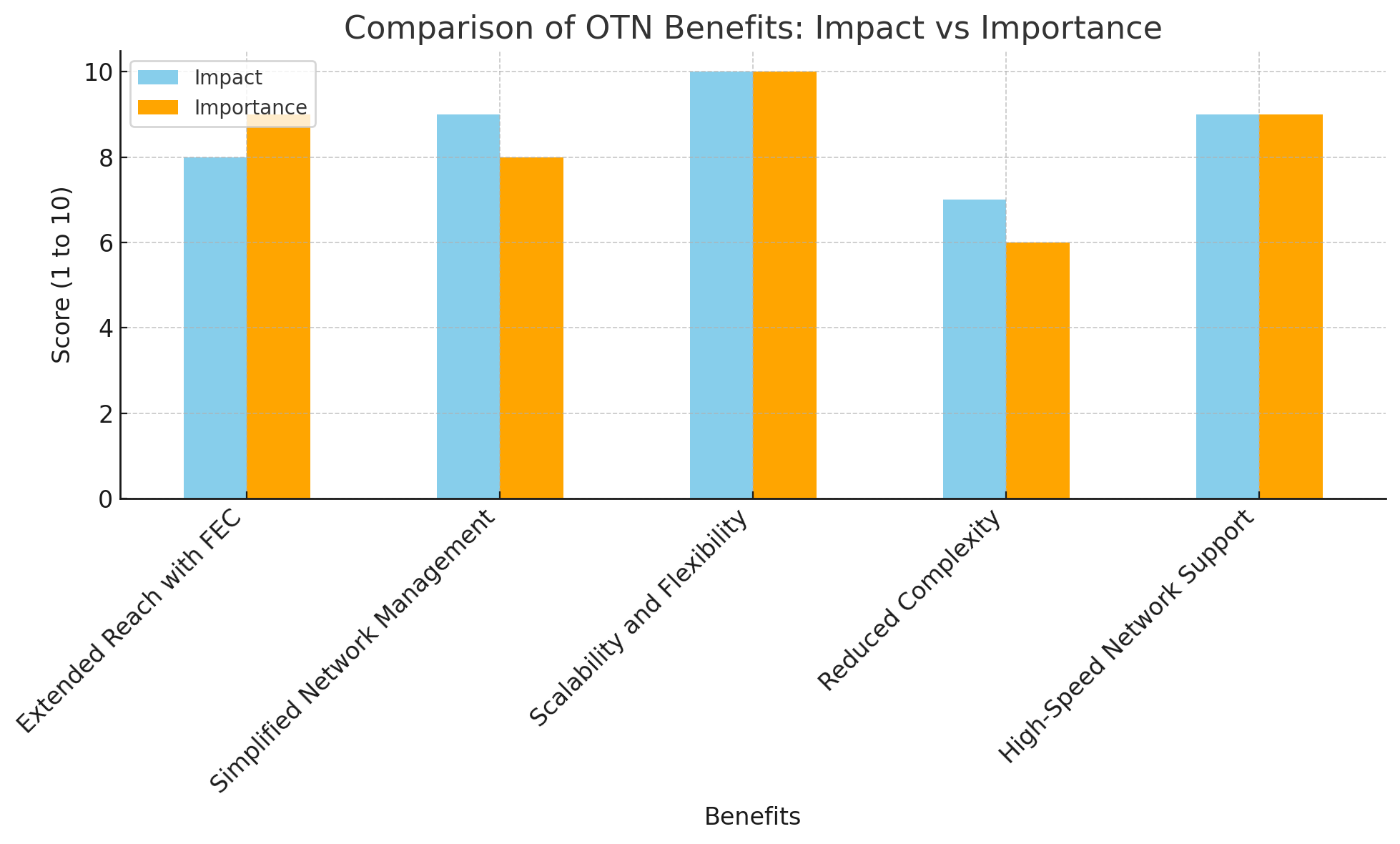
While Dense Wavelength Division Multiplexing (DWDM) is an essential technology for multiplexing optical wavelengths, OTN offers additional intelligence that DWDM alone cannot provide. DWDM focuses primarily on increasing bandwidth by transmitting multiple signals over a single optical fiber, but it lacks the ability to perform error correction or service monitoring.
OTN, on the other hand, encapsulates data into standardized containers, providing a higher level of functionality. In addition to offering the same bandwidth as DWDM, OTN provides Forward Error Correction (FEC), end-to-end monitoring, and more efficient use of network resources. This makes OTN more suitable for managing complex, high-performance networks that require reliability and scalability.
Unlike SONET/SDH, which was designed for voice-centric services, OTN supports a wide range of data-centric applications. OTN enables higher bandwidth and more flexible transport of data types, including IP, Ethernet, and digital video. Additionally, the advanced error correction and monitoring features of OTN significantly improve network reliability, making it more suitable for today’s data-intensive applications.
OTN also reduces network complexity by integrating multiple services into a single network layer, eliminating the need for separate infrastructure for different services. This simplification of network management not only reduces operational costs but also improves the efficiency of network resource utilization.
Characteristic | OTN | Traditional Methods (e.g., SONET/SDH, DWDM) |
Data Transport | Uses a digital wrapper for efficient signal encapsulation. | Primarily relies on optical multiplexing and signal regeneration. |
Error Correction | Built-in error correction with FEC for reliable transmission. | Typically requires additional regeneration points. |
Service Flexibility | Supports multiple services (Ethernet, Fibre Channel, IP, etc.) | Limited to specific service types (e.g., SONET, SDH). |
Network Scalability | Highly scalable for future technologies like 5G, AI. | Less scalable for modern, high-bandwidth applications. |
OTN is increasingly used in data centers to support high-speed interconnections between servers and storage systems. As data centers expand to support cloud services, OTN provides the high-capacity transport needed for large-scale data operations. By utilizing OTN’s ability to map various client signals into a single transport layer, data centers can streamline operations, reduce overhead, and improve scalability.
In cloud networks, OTN enables the fast, reliable transfer of data between different regions, ensuring high availability and low-latency communication. The flexibility of OTN ensures that cloud service providers can meet the growing demands for data bandwidth while maintaining optimal performance.
OTN serves as the backbone of modern telecom networks, providing the reliability and scalability required to support diverse communication services. By consolidating multiple services into a single optical transport layer, telecom providers can reduce infrastructure costs and improve network efficiency.
The integration of various client protocols, such as Ethernet, Fibre Channel, and SONET/SDH, into a unified OTN network allows for seamless communication across different services. This service convergence enables telecom operators to offer more flexible and customizable services to their customers.
OTN is essential for supporting high-bandwidth applications like 4K video streaming, IoT, and AI. These applications require large amounts of data to be transmitted quickly and reliably. OTN’s ability to provide low-latency, high-capacity transport makes it an ideal solution for meeting the demands of these bandwidth-intensive services.
Additionally, OTN’s support for emerging protocols such as 400GbE and FlexE ensures that networks can continue to evolve and meet future bandwidth requirements without requiring a complete overhaul of existing infrastructure.
Application Area | OTN Role |
Data Centers & Cloud Networks | Ensures high-capacity, reliable interconnects between data centers. |
Telecommunications | Acts as the backbone for modern telecom infrastructures. |
High-Bandwidth Applications | Supports video streaming, IoT, and other bandwidth-intensive applications. |
Next-Generation Technologies | Facilitates the integration of services like 5G, AI, and cloud workloads. |
While OTN offers significant long-term benefits, the initial cost of deploying OTN infrastructure can be high. Service providers need to invest in specialized equipment, including optical transponders, multiplexers, and amplifiers, to set up OTN networks. These upfront costs can be a barrier for smaller providers or businesses with limited budgets.
However, the cost savings provided by OTN’s reduced regeneration needs, simplified network management, and increased efficiency can offset the initial investment over time. By leveraging the scalability of OTN, service providers can gradually expand their network as demand grows, minimizing the financial impact.
Integrating OTN into existing network architectures can be complex, particularly for legacy systems. OTN requires specialized knowledge and expertise to design, deploy, and maintain, which may necessitate additional training for network engineers and technicians.
Despite these challenges, OTN’s benefits in terms of scalability, efficiency, and performance make it a worthwhile investment for service providers looking to future-proof their networks and support next-generation services.
OTN plays a crucial role in the rollout of 5G networks, which require high-speed, low-latency transport to support large numbers of devices and applications. OTN’s ability to provide reliable, high-capacity transport makes it ideal for the backhaul and fronthaul segments of 5G networks.
Similarly, OTN is well-suited for the growing demands of AI and big data workloads. As these technologies generate vast amounts of data, OTN provides the necessary bandwidth and low-latency transport to support real-time processing and analysis.
The future of OTN is bright, with continuous advancements in the technology driving the development of higher data rates and more efficient network architectures. New standards, such as the OTUCn frame structure and FlexO, are enabling OTN to support even faster speeds and more complex services.
As networks evolve to accommodate emerging technologies, OTN will continue to serve as a foundational technology, providing the flexibility and scalability needed to meet the demands of future communications.
OTN is essential for modern telecom and data center industries, providing high-capacity, low-latency transport. It simplifies network management and supports future technologies like 5G, AI, and cloud computing. As demand for bandwidth increases, OTN will remain critical for efficient, scalable data transport. Businesses should explore OTN solutions, like those from ZHIYI, to optimize network efficiency and ensure future-proof infrastructures.
A: OTN (Optical Transport Network) is a standardized technology for efficient data transport over optical networks. It ensures high-capacity, low-latency communication and error correction. An Optical Transmitter plays a key role by converting electrical signals into optical signals for transmission.
A: While DWDM focuses on wavelength multiplexing, OTN adds a digital wrapper for error correction and monitoring. The Optical Transmitter in OTN ensures high-quality signal conversion, making it ideal for complex network management.
A: OTN provides extended reach, low-latency transport, and service convergence. With Optical Transmitters, it ensures high-efficiency signal conversion, enabling reliable communication across networks.
A: Yes, OTN supports high-bandwidth, low-latency traffic needed for technologies like 5G and AI. The Optical Transmitter ensures that the high-speed data is efficiently transmitted over long distances, supporting the demand of modern workloads.
A: Deploying OTN can be costly and complex due to the need for specialized equipment. Optical Transmitters are essential for the signal conversion but require precise integration into the network to ensure efficiency and reliability.


