- All
- Product Name
- Product Keyword
- Product Model
- Product Summary
- Product Description
- Multi Field Search

Views: 0 Author: Site Editor Publish Time: 2026-11-13 Origin: Site
As a network engineer who has spent years designing sprawling optical backbones, I have seen firsthand how the global appetite for data continues to grow at an unprecedented rate. From dense Fiber to the Home deployments to large-scale CATV networks, the pressure on existing infrastructure is immense. As network topologies expand, inevitable signal degradation becomes a critical bottleneck. To overcome this hurdle, deploying a High Power EDFA is indispensable. These advanced modules keep data streams pristine. They boost optical signals directly, completely bypassing the need for costly and slow electrical conversion.
This comprehensive guide evaluates the premier amplification technologies available today. We will compare pure models against hybrid configurations and provide actionable insights. My goal is to help you select the optimal hardware for your specific network architecture, ensuring maximum scalability and performance without overspending on unnecessary features.
These robust amplifiers are vital for transmitting 1550nm signals across extensive distances. They effectively minimize loss in modern telecom and broadcast systems.
When evaluating hardware in the field, saturation output power, gain flatness, and noise figures remain the most critical performance metrics.
While hybrid amplifiers offer exceptionally low noise for ultra-long links, pure high-power systems stand out as the most cost-effective and reliable choice for metropolitan distribution.
Multi-port configurations drastically reduce the total equipment footprint. This approach slashes both capital and operational expenditures in passive optical network deployments.
Intelligent thermal management and advanced pump power controls are non-negotiable features for ensuring enterprise-grade longevity.
Standard units typically utilize erbium-doped fiber pumped by 980nm or 1480nm lasers. While they are perfectly adequate for basic point-to-point links, modern bandwidth demands require significantly more muscle. Transitioning to a 32-Ports 1550nm High Power EDFA represents a massive leap from simple signal boosting to robust, high-density distribution. These advanced systems deliver output powers ranging from one watt to several watts. Consequently, they can effortlessly manage the complex signal splitting requirements inherent in split-heavy FTTH environments without breaking a sweat.
The utility of these devices extends far beyond basic telecom operations. They serve as the critical backbone for long-haul WDM networks, where preserving signal integrity over hundreds of kilometers is an absolute necessity. Furthermore, in highly specialized fields such as LiDAR systems and free-space optical communication, the precise and stable power output provided by these units is critical for accurate data capture. For CATV and IPTV providers, they ensure that high-bandwidth video streams reach tens of thousands of subscribers simultaneously without pixelation or lag.
When selecting an amplifier for a new build, saturation output power measured in dBm is arguably the primary metric. It directly dictates how many downstream nodes a specific system can comfortably illuminate. A higher rating allows the module to maintain robust signal strength even after passing through multiple passive splitters. In addition, efficiency is equally vital. A well-engineered unit converts pump laser energy into optical gain with minimal waste. This directly lowers the long-term cooling and operational costs of your server facility.
The Noise Figure measures the inevitable degradation of the Signal-to-Noise Ratio introduced by the amplification process itself. In high-power applications, maintaining a Noise Figure between 4.5 dB and 5.5 dB is a formidable technical challenge. Yet, it is absolutely essential for keeping data pristine. Elevated noise floors trigger bit errors. This practically limits the distance a signal can travel before requiring complete, costly regeneration. Therefore, selecting hardware with superior noise suppression is a direct investment in network reliability.
For Wavelength Division Multiplexing systems, the amplifier must provide consistent, flat gain across the entire optical C-band from 1530nm to 1565nm. If the gain fluctuates significantly between channels, some wavelengths will become dangerously weak. Meanwhile, others may become overpowered and trigger nonlinear optical distortions. A perfectly flat gain profile guarantees that all multiplexed data streams are treated equally. This drastically simplifies head-end network management.
To make an informed decision, engineers must understand the distinct advantages of each amplification technology. Below is a core comparison table that breaks down the practical differences.
Technology Type | Optimal Wavelength | Noise Profile | Best Application Scenario | Cost Effectiveness |
|---|---|---|---|---|
Pure High Power EDFA | 1550nm C-Band | Moderate to Low | Metro networks, FTTH, CATV distribution | Excellent — High ROI for access networks |
EDFA-Raman Hybrid | C-Band and L-Band | Ultra-Low | Submarine links, ultra-long-haul backbones | Poor — High initial cost and complex maintenance |
TDFA Thulium-Doped | 1460nm S-Band | Moderate | Specialized S-band transmission only | Niche — Expensive due to low market volume |
Pure systems have long maintained their status as the industry standard due to their operational maturity and unshakeable reliability. They remain exceptionally cost-effective and deliver rock-solid performance strictly within the 1550nm window. Because they can be easily configured into dense, multi-port architectures, they are the pragmatic choice for access networks where rack space and energy consumption are highly scrutinized.
In contrast, hybrid amplifiers fuse the high-gain capacity of traditional erbium with the distributed gain characteristics of Raman amplification. While this powerful synergy offers unmatched noise reduction over ultra-long trans-continental links, it is frequently overkill for standard deployments. The added complexity, delicate maintenance, and steep cost of Raman pumps make them a niche solution compared to straightforward pure models.
While Thulium-Doped Fiber Amplifiers carve out a specific niche for S-band transmission, Erbium wholly dominates the C-band and L-band. Because the vast majority of commercial high-power deployments rely on the 1550nm C-band, the mature global ecosystem of compatible filters, splitters, and transceivers firmly cements the EDFA as the superior scaling solution.
Recent market analyses and field deployments highlight a massive architectural shift toward space-division multiplexing and co-packaged optics. This shift is primarily driven by the need to handle surging, AI-driven data center traffic. As cloud providers and tier-one telecom operators push aggressively for 800G and 1.6T transmission rates, the demand for highly efficient optical amplification is skyrocketing.
Industry experts note a distinct trend where operators are abandoning power-hungry legacy repeaters. Instead, they are favoring ultra-compact, high-density Erbium-Ytterbium co-doped fiber amplifiers. The global consensus is clear. Future-proofing optical infrastructure now hinges heavily on deploying amplification hardware that offers maximum port density per rack unit while strictly minimizing the electrical power consumed per bit transmitted.
The single-pass architecture stands as the most common linear design. Here, the input signal traverses the active erbium-doped fiber exactly once. This straightforward configuration is heavily favored by engineers for its inherent stability and budget-friendly nature. It perfectly serves environments that require moderate to high gain without the added complexity of convoluted optical feedback loops.
Conversely, a double-pass system forces the signal to reflect and travel through the erbium fiber a second time. This ingenious method drastically boosts gain efficiency, extracting significantly higher output power from a much shorter length of fiber. However, this sophisticated design demands rigorous optical isolation to prevent Amplified Spontaneous Emission from leaking back into the input stream. It is ideal for ultra-compact applications but requires far higher engineering precision.
As fiber networks densify to support gigabit speeds, the archaic approach of cascading dozens of single-output amplifiers has become entirely unsustainable. Each added unit devours valuable rack space, spikes thermal loads, and introduces new potential points of hardware failure. Consequently, operators are rapidly pivoting toward integrated, high-density multi-port solutions. Consolidating distribution hardware slashes the total cost of ownership and immensely simplifies routine maintenance.
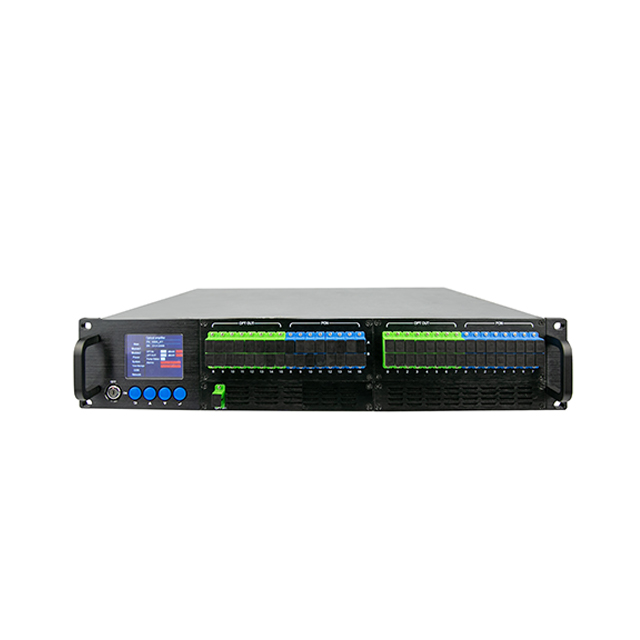
For sprawling, large-scale distribution scenarios, utilizing a Zhiyi 32-Ports 1550nm High Power EDFA is widely recognized by field engineers as a premier strategy. This specific unit can achieve a staggering total output power of up to 40 dBm. It divides this massive power pool evenly, outputting a stabilized 10 to 22 dBm across 32 independent ports.
Equipped with top-tier JDSU or Lumentum pump lasers and dual hot-swappable power supplies, it acts as the perfect high-capacity interface between OLT equipment and the subscriber network. Furthermore, its built-in CWDM capabilities seamlessly multiplex 1550nm video overlays with existing GPON or XG-PON data streams, actively preventing cross-talk interference.
Enterprise-grade reliability in high-power optics is strictly governed by the sophistication of its internal control mechanisms. Automatic Power Control maintains unwavering output regardless of sudden input signal fluctuations. Meanwhile, Automatic Current Control keeps the pump laser diodes operating safely within optimal electrical parameters. Furthermore, Automatic Temperature Control actively manages thermal shifts. Together, these smart systems protect the delicate internal components from burning out during unexpected outages or configuration errors.
Thermal dissipation remains the most formidable hurdle for high-power optical modules. Recent manufacturing innovations utilize advanced copper heat sinks and optimized aerodynamic airflow chassis designs. These upgrades now empower units to operate flawlessly under heavy loads. By aggressively mitigating heat-related degradation, modern telecom equipment can easily achieve operational lifespans exceeding ten years, even in sweltering, densely packed server racks.
Avoid abstract guessing when procuring hardware. Use this actionable checklist to align your equipment choice with actual field requirements.
Meticulously map out your network topology. If you are managing a straightforward point-to-point backhaul link, a single-port module is perfectly adequate. On the other hand, designing a sprawling point-to-multipoint FTTH network demands a robust multi-port solution. Calculate your total optical budget by factoring in fiber distance attenuation and passive splitter losses. This exact math will dictate the total dBm output and port density you require.
Always verify that your selected hardware is fully optimized for the 1550nm transmission window. Look for modern multi-port units that integrate built-in WDM. This crucial feature enables network engineers to effortlessly combine legacy 1550nm RF video signals with modern PON data streams. Ensuring this backward compatibility is essential for avoiding signal interference and maximizing the lifespan of your existing head-end hardware.
It is a common operational pitfall to evaluate hardware solely based on the initial sticker price. The true Total Cost of Ownership encompasses hardware longevity, routine maintenance hours, and ongoing energy consumption. Investing upfront in a premium High Power EDFA pays massive dividends over time. It effectively eliminates the need for mid-span repeaters, reduces costly truck rolls, and drastically minimizes network downtime.
As advanced photonics continue to evolve, the reliance on robust, clean, and highly efficient signal amplification will only intensify. High-capacity optical amplifiers form the undisputed backbone of modern 1550nm optical networks, seamlessly driving data across vast distances. While hybrid systems certainly hold value for niche ultra-long-haul applications, integrated multi-port pure EDFAs consistently deliver the best return on investment for standard metro and local access architectures.
When planning your next major infrastructure upgrade, prioritize high port density, intelligent thermal management, and seamless WDM integration. To ensure your fiber network remains agile and scalable for decades to come, I highly recommend exploring the specialized configurations available at Zhiyi to find the exact match for your optical power requirements.
While standard models typically output around 10 to 20 dBm, high-power variants utilize cladding-pumped technologies—often employing Erbium-Ytterbium co-doped fiber—to achieve total outputs exceeding 30 to 40 dBm. This massive power pool is then evenly and safely split across multiple distribution ports for FTTH applications.
Absolutely. Modern multi-port models frequently feature built-in Wavelength Division Multiplexing. This crucial feature enables operators to seamlessly multiplex 1550nm analog or digital video signals with 1310nm or 1490nm data signals. It makes unified FTTH integration incredibly straightforward and efficient.
A traditional unit relies solely on Erbium ions for 1550nm amplification. In contrast, an EYDFA utilizes Erbium-Ytterbium co-doped fiber. The strategic addition of Ytterbium allows the fiber to absorb significantly more pump laser power. This enables the amplifier to achieve much higher total output levels without suffering from nonlinear optical degradation.
Raman amplifiers provide distributed gain directly along the transmission fiber itself, resulting in exceptionally low noise over vast distances. Hybrids combine this distributed gain with high output. However, pure high-power systems are considerably easier to install, significantly more cost-effective, and perfectly sufficient for standard metro or local access networks.
The 1550nm wavelength sits squarely within the optical C-band. This specific transmission window corresponds to the absolute lowest attenuation rate in standard silica optical fibers. It is the undisputed ideal choice for long-distance, high-capacity signal transmission.
To calculate the required power budget, you must add up the total insertion loss of your optical splitters, the attenuation of the fiber length usually 0.2 dB per kilometer at 1550nm, and the minimum receiver sensitivity of the end-user equipment. Add a 3 dB safety margin to this total. Your amplifier's per-port output must exceed this final number.
When equipped with intelligent thermal management and premium pump lasers like those from Lumentum or JDSU, a high-quality amplifier can easily operate continuously for 10 to 15 years. Regular maintenance of facility cooling and ensuring a dust-free rack environment will further maximize this operational lifespan.