- All
- Product Name
- Product Keyword
- Product Model
- Product Summary
- Product Description
- Multi Field Search

Views: 0 Author: Site Editor Publish Time: 2026-11-19 Origin: Site
The landscape of optical communications is rapidly expanding beyond traditional terrestrial telecom networks. Today, optical engineers and network architects are pushing the boundaries of data transmission. They are venturing into Free-Space Optical Communications for space links. Simultaneously, they are deploying revolutionary Hollow-Core Fiber for ultra-low latency terrestrial networks. At the heart of these next-generation advancements lies a critical piece of technology. This is the High Power EDFA.
Space links suffer from massive distance-related signal loss and atmospheric interference. Furthermore, hollow-core fibers can handle significantly more optical power without distortion compared to traditional solid glass. Therefore, standard optical amplifiers are simply no longer sufficient. This comprehensive guide explores why high-power amplification is the essential engine driving these cutting-edge applications. We will break down how the technology works and detail the exact criteria you must consider when choosing the right amplifier for your high-capacity optical projects.
Essential for Next-Gen Networks: High-power amplification is mandatory for overcoming the massive optical link budgets required in satellite-to-ground space links.
Unlocking Hollow-Core Fiber: Advanced amplifiers allow engineers to push maximum optical power through hollow channels without triggering non-linear penalties.
The 1550nm Advantage: Operating in the 1550nm band ensures minimal atmospheric absorption for space links and aligns perfectly with modern low-loss fiber optics.
Versatility in Application: Beyond space and specialized fiber, multi-port high-power solutions are highly sought after for FTTH, CATV, and LiDAR distribution networks.
Smart Purchasing Criteria: Selecting the correct amplifier requires careful evaluation of output power, noise figure, port configuration, and thermal resilience.
An Erbium-Doped Fiber Amplifier operates as a fundamental optical device designed to boost signal intensity. It achieves this without the need for cumbersome optical-to-electrical conversion. This amplification occurs directly in the optical domain, specifically targeting the 1550nm wavelength window. This window remains the gold standard for long-haul telecommunications due to its minimal attenuation. The mechanism relies on a segment of silica fiber doped with erbium ions. When a pump laser injects energy into the fiber, it excites these ions. The ions then release photons to multiply the incoming signal strength through stimulated emission.
Standard modules work perfectly fine for conventional terrestrial loops. However, they encounter strict physical ceilings when higher output is mandated. A typical core-pumped amplifier usually tops out at 20 to 23 dBm. Venturing beyond this limit results in severe efficiency losses and thermal instability. In contrast, a high-power architecture utilizes Erbium and Ytterbium co-doped double-clad fibers. This specific doping significantly enhances pump light absorption. It enables the use of robust multimode pump lasers, allowing the device to scale outputs beyond 30 dBm or even 40 dBm. This design effectively distributes thermal loads while preserving the integrity of the single-mode signal core.
Feature | Standard EDFA | High Power EDFA |
|---|---|---|
Max Output Power | Up to 23 dBm | 30 dBm to 40+ dBm |
Fiber Architecture | Single-clad Erbium-doped | Double-clad Er/Yb co-doped |
Pump Laser Type | Single-mode pump | Multimode pump |
Primary Use Case | Standard metro telecom links | Space links, FTTH distribution, LiDAR |
Transmitting laser signals through the Earth atmospheric layers is a Herculean task. The path is plagued by water vapor absorption and thermal turbulence. These environmental factors can induce massive signal attenuation of tens of decibels, effectively muting the data stream. High-power amplification acts as the necessary remedy here. It provides the massive link margin required to punch through atmospheric disturbances. This ensures that the ground station receives a signal robust enough for accurate, error-free decoding.
The rapid proliferation of Low Earth Orbit constellations has revolutionized global connectivity. Yet, this web of satellites demands highly sophisticated inter-satellite optical links. Unlike traditional radio-based systems, these optical paths require precise beam steering and substantial power. High power is critical to mitigate the effects of beam divergence over thousands of kilometers in a vacuum. Industry observers note a distinct shift toward integrating these high-power modules directly into satellite payloads. This integration maintains stable, high-speed data handshakes between space-borne nodes and ground segments.
The preference for 1550nm is not accidental. It is driven by empirical physics and strict safety regulations. This band experiences minimal Rayleigh scattering and solar background noise compared to shorter wavelengths. Furthermore, it is classified as eye-safe. This is a vital regulatory prerequisite that permits much higher transmission power levels. Consequently, it is the practical choice for signals that must pass through populated terrestrial areas to reach their final destination.
Recent market analyses reveal a fascinating convergence in the optical sector. Major aerospace organizations are aggressively shifting from radio frequencies to optical links to achieve gigabit-per-second throughput. Concurrently, the financial and algorithmic trading sectors are racing to lay Hollow-Core Fiber to shave microseconds off data transmission times. Both of these booming industries share a common bottleneck: the need for pristine, ultra-high-power optical amplification. The demand for ruggedized, high-output optical engines is growing exponentially. Manufacturers are responding by developing highly integrated chassis that combine massive power output with intelligent network management systems.
Hollow-Core Fiber is fundamentally changing the physics of signal transmission. By guiding light through an air-filled or vacuum-filled microscopic channel, this fiber enables signals to travel roughly 33 percent faster than in solid silica. This physical shift translates to an approximate 1.5-microsecond-per-kilometer reduction in delay. This is a critical asset for sectors that view absolute minimal latency as their primary currency.
Optical engineers have long struggled with the limitations of solid glass fibers. In solid silica, injecting high optical power triggers non-linear effects like Stimulated Brillouin Scattering or Self-Phase Modulation. These effects distort signal waveforms, creating a hard power ceiling. Since light in a hollow core interacts primarily with air, these non-linearities are effectively neutralized. As a result, architects can push significantly more power through the fiber using a reliable 1550nm High Power EDFA. This extends the transmission reach immensely while maintaining the pristine quality of the data waveform.
Beyond the high-tech corridors of satellite links, these amplifiers are absolute workhorses in residential broadband distribution. In scenarios requiring a single feed to reach thousands of subscribers, the insertion loss from optical splitters is massive. High-power multi-port units effectively bridge this gap. They ensure that every single home receives a high-fidelity signal. This approach is instrumental in scaling existing fiber-to-the-home architectures without incurring the prohibitive costs of adding more headend equipment.
In traditional long-haul environments, the standard practice was the frequent deployment of inline repeaters. Recent engineering trends favor unrepeatered designs. In these layouts, massive power injected at the source allows signals to traverse significantly longer distances without amplification checkpoints. This not only reduces capital expenditure on subsea or remote terrestrial stations but also minimizes points of failure. Ultimately, this boosts overall network reliability.
The precision of LiDAR systems relies heavily on the intensity of the emitted light pulse. High-power amplifiers provide the required peak power to ensure that reflected light returns from distant or obscurant-filled environments. Whether mapping through thick fog or heavy dust, the returned signal must have sufficient strength to be measured accurately. This capability is pushing the effective range and resolution of remote sensing equipment to unprecedented new levels.
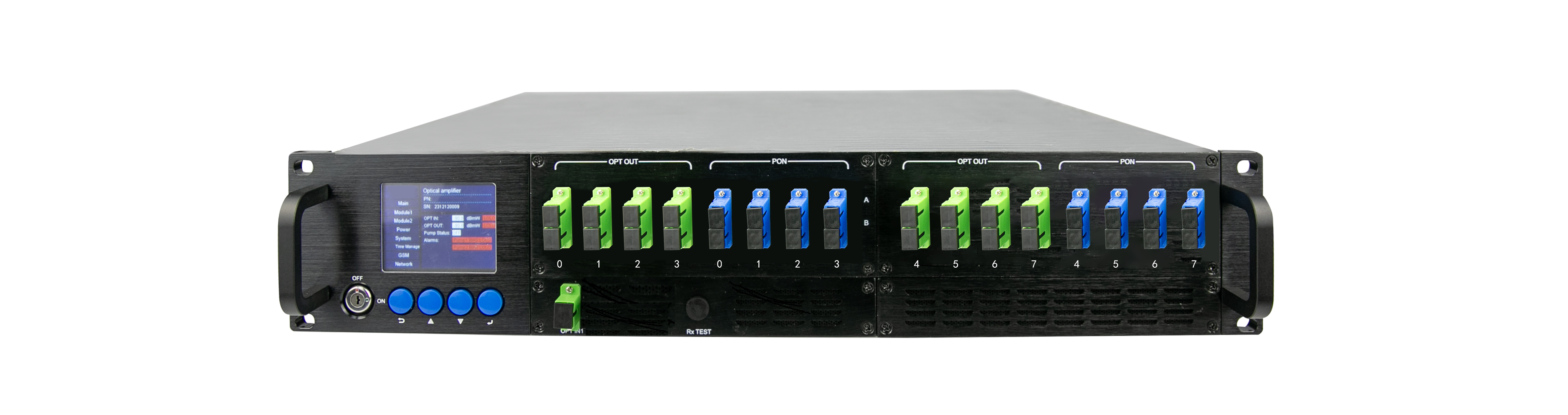
The saturation output power is your most important metric. Before procurement, you must rigorously calculate the total path loss. This includes fiber attenuation, connector losses, and exact splitter ratios. For large distribution networks, port configuration is equally vital. For example, deploying a 16-port High Power EDFA allows an engineer to distribute up to 37 dBm of total power evenly across 16 individual outputs. This provides roughly 10 to 22 dBm per port, depending on the specific model, ensuring massive coverage from a single rack unit.
Amplification is never a perfectly clean process. It always introduces Amplified Spontaneous Emission noise. A low noise figure, ideally kept under 5.5 dB, is vital for maintaining an acceptable Optical Signal-to-Noise Ratio. In multi-stage cascades, this background noise compounds rapidly. Making the initial choice of a high-quality, low-noise amplifier is a strategic priority for long-term network performance.
For modern distribution networks, chassis configuration dictates your management efficiency. Advanced amplifiers now incorporate built-in Wavelength Division Multiplexing features. This allows operators to seamlessly multiplex 1550nm video signals with 1310nm and 1490nm data signals on a single fiber strand. This consolidation is a key step in maximizing fiber utility and simplifying rack-level logistics.
Success in optical engineering starts with precise math. You must account for every single decibel of loss in your fiber plant. Once you have a clear picture of the total passive loss, you can select an amplifier that hits the sweet spot. It must provide sufficient power for the receiver without pushing the signal into deep saturation, which can actually degrade data quality and cause bit errors.
Because these devices handle significant optical and electrical power, they generate considerable heat. When selecting your hardware, prioritize units with robust thermal management. Look for dual redundant power supplies, variable-speed intelligent fans, and high-efficiency heat sinks. Furthermore, ensure the system supports SNMP network monitoring. This provides the real-time visibility needed to react before a minor temperature fluctuation turns into a major network outage.
The evolution of optical networks relies entirely on robust optical amplification. Whether you are reaching into the stars via satellite links or achieving near-light-speed data transfers through Hollow-Core Fiber, power is everything. A high-output amplifier is no longer just a luxury. It is a foundational necessity for overcoming signal attenuation and maximizing the potential of modern infrastructure. Whether you are designing a deep-space communication array or upgrading a local FTTH grid, choosing the right hardware is your most critical decision. By understanding your link budget and port requirements, you can secure the ideal optical amplification solutions to future-proof your network for decades to come.
While standard telecom amplifiers typically output between 13 dBm and 23 dBm, high-power variants utilize Erbium and Ytterbium co-doped fiber. This advanced doping allows them to achieve total output powers ranging from 27 dBm up to 40 dBm, depending on the specific application requirements and pump laser configuration.
The 1550nm band is highly favored for Free-Space Optical Communications because it experiences much lower atmospheric scattering and absorption compared to shorter wavelengths. Additionally, it is considered eye-safe. This specific classification allows engineers to transmit at much higher power levels without posing a danger to human eyes on the ground.
Technically, they can be connected, but they completely fail to maximize the unique potential of the fiber. Hollow-core channels have an incredibly high threshold for non-linear optical effects. To take full advantage of this, engineers utilize high-power units to inject significantly more light than would be possible in standard solid silica fiber. This results in longer transmission distances without any signal distortion.
This specific configuration is primarily used in optical distribution networks, such as FTTH and CATV systems. It accepts a single optical input, amplifies it to a massive power level, and splits it evenly across 16 output ports. This allows a single network feed to serve thousands of end-user premises efficiently and reliably from one centralized rack device.
Raman amplifiers utilize the transmission fiber itself as the amplification medium through stimulated Raman scattering, which provides distributed amplification with very low noise. In contrast, an EDFA provides lumped amplification within a specific doped fiber spool inside the device chassis. High-power EDFAs are generally more cost-effective and provide significantly higher raw output power, making them ideal for signal boosting before transmission or splitting.
Generating up to 40 dBm of optical power requires high-current pump lasers that produce substantial heat. Professional-grade amplifiers utilize a combination of heavy-duty aluminum heat sinks, internal temperature sensors, and microprocessor-controlled variable-speed cooling fans. If internal temperatures rise, the fans automatically accelerate to dissipate heat. High-end models also include automatic laser shutdown protocols to prevent hardware damage if cooling fails.