- All
- Product Name
- Product Keyword
- Product Model
- Product Summary
- Product Description
- Multi Field Search

Views: 0 Author: Site Editor Publish Time: 2026-11-07 Origin: Site
Network upgrades to 100G, 400G, and beyond often force engineers into a difficult corner. You need massive capacity to handle surging data demands, but you absolutely cannot sacrifice carrier-grade stability. The ongoing debate between Wavelength Division Multiplexing and Optical Transport Network architectures is far more than a simple technical dispute. It dictates your long-term operational costs and network resilience. WDM delivers sheer bandwidth expansion by multiplying fiber lanes. OTN brings the intelligent traffic management required to keep those lanes running smoothly. Reconciling these two technologies requires a solid physical foundation. Deploying a robust OTN/WDM Chassis serves as that exact bedrock for a future-proof communications infrastructure.
Looking at current industry shifts, global bandwidth consumption is forcing a rapid migration toward 400G and 800G coherent optics. Network operators are actively moving away from siloed, independent systems. Instead, the market heavily favors converged platforms. Integrating physical layer multiplexing with digital wrapper technology reduces both rack footprint and power consumption. This convergence means you no longer have to compromise. You can deploy a unified architecture that handles both raw spectral efficiency and granular service grooming simultaneously.
Think of WDM as a multi-lane fiber highway. By transmitting multiple light wavelengths simultaneously across a single glass strand, it instantly multiplies your existing physical capacity. It effectively paves new lanes on a congested data path. However, raw optical bandwidth completely lacks traffic control logic. This is exactly where OTN steps in. Defined by the G.709 international standard, it acts as a digital wrapper. It provides the critical intelligence missing in legacy transmission systems.
WDM handles the raw physics of light transmission. OTN manages the data integrity through robust Forward Error Correction. It ensures that every packet reaches its destination without corruption. Modern network designs show a massive shift toward converged architectural setups. In these professional environments, an integrated unified optical transport platform delivers the physical housing necessary for seamless digital evolution.
Distinguishing these two technologies is critical for resilient network design. WDM roots itself entirely in spectral efficiency. Its primary job is pushing the maximum volume of physical data through a single fiber core. Conversely, OTN prioritizes service reliability and end-to-end transparency. It treats data payloads like secure, trackable parcels. The protocol wraps these payloads with digital headers that enable precise error detection and granular performance monitoring.
Traditional pure WDM systems lack comprehensive Operations, Administration, and Maintenance capabilities. This severe deficiency often leads to agonizing troubleshooting sessions during unexpected network outages. OTN solves this by offering layer-2 transparency. It perfectly balances raw optical throughput with the intelligence needed to manage complex, multi-service traffic flows.
Feature | WDM Layer | OTN Layer |
|---|---|---|
Primary Goal | Raw capacity expansion | Intelligent traffic management |
Error Handling | Basic hardware alerts | Advanced Forward Error Correction |
Service Mapping | Protocol transparent | Dynamic grooming and multiplexing |
Diagnostics | Minimal optical monitoring | Comprehensive remote monitoring |
Sometimes, the most elegant engineering strategy is the simplest one. Pure DWDM deployments absolutely shine in Data Center Interconnect environments. In these specific scenarios, minimizing latency is your absolute top priority. For high-speed, dedicated point-to-point links, the computational overhead of complex digital wrappers is simply unnecessary.
From a capital expenditure standpoint, pure WDM hardware runs leaner. It provides massive raw speed for short-reach scenarios without the premium cost of advanced intelligence features. Nevertheless, you must weigh a significant trade-off. Pure WDM lacks granular service control. You cannot easily isolate or switch specific sub-wavelength traffic. If your network topology evolves beyond a simple direct fiber connection, a basic WDM setup quickly becomes a rigid bottleneck.
As your infrastructure scales, raw speed loses its crown to network flexibility. OTN introduces intelligent grooming capabilities. This allows network engineers to map diverse, lower-rate client services into massive transport containers. Consolidating Ethernet, Storage Area Networks, and video traffic onto a single carrier maximizes your expensive fiber utilization.
Furthermore, modern digital controllers enable dynamic traffic switching. As your enterprise grows, you avoid catastrophic rip-and-replace backbone upgrades. This carrier-grade reliability is mandatory for long-haul networks. Every bit of transmitted bandwidth represents a heavy financial investment. The ability to remotely monitor performance and enforce strict Service Level Agreements makes OTN non-negotiable for complex mesh topologies.
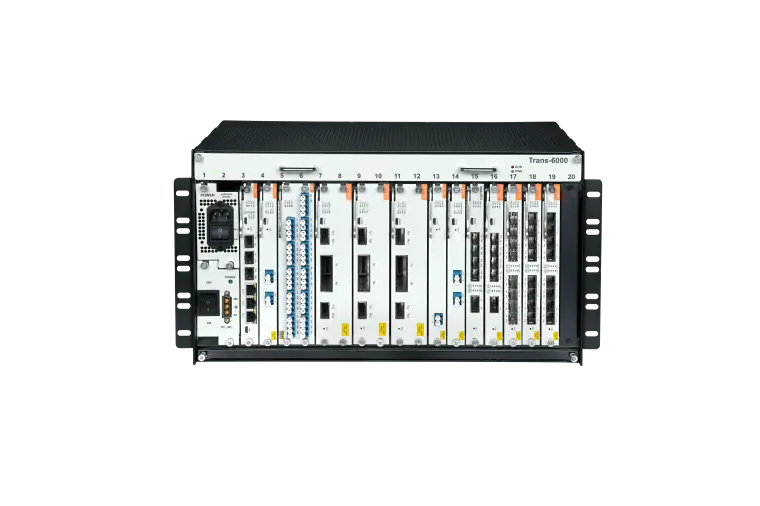
Selecting the right physical hardware ties your entire optical strategy together. A modular approach ensures your environment adapts seamlessly as data demands surge. High-quality equipment, like the ZY-Trans series, acts as the central nervous system of your infrastructure. A carrier-grade scalable OTN/WDM Chassis houses transponders, muxponders, and optical amplifiers within a single streamlined unit.
This physical consolidation drastically reduces rack space and slashes power consumption. Professional chassis designs feature 1U, 2U, or 5U form factors equipped with redundant, hot-swappable power supplies and cooling fans. You can plug in simple WDM line cards today and seamlessly transition to 100G or 200G OTN modules tomorrow. This modular hardware strategy protects your initial capital investment while keeping your network agile.
How do you finalize your architectural path? Start by auditing your current traffic profile. Are you pushing identical, massive data streams, or managing a chaotic mix of client services? Next, evaluate your physical topology. Simple point-to-point fiber links heavily favor WDM. Complex mesh or ring networks demand the switching power of OTN to maintain traffic efficiency.
Finally, define your operational standards. If your engineering team requires strict remote troubleshooting and precise fault isolation, OTN is your only viable route. Always prioritize hardware capable of supporting future coherent optics and higher bandwidth capacities to ensure long-term competitiveness.
Integration fears often keep network engineers awake at night. The biggest myth in the industry is that adding digital wrappers introduces unacceptable transmission latency. In reality, modern ASIC-based hardware performs these framing operations at absolute wire speed. The latency penalty is virtually zero for standard enterprise applications.
Instead of obsessing over microsecond delays, focus on management compatibility. Your chosen modular OTN/WDM chassis equipment must integrate smoothly with your existing Network Management System. A well-engineered platform delivers a true plug-and-play deployment experience. Ultimately, successful implementation balances your initial hardware investment against the massive operational savings gained through automated fault detection.
The modern optical transport debate is rarely a strict binary choice. High-performance networks demand a strategic blend of both technologies. Leveraging spectral capacity alongside digital intelligence builds a resilient backbone ready for tomorrow. Stop compromising between raw capacity and traffic control. Upgrade your infrastructure with a modular platform designed for seamless scaling. Explore the full range of high-performance transmission equipment at Zhiyicom to find the exact configuration that meets your network demands today and secures your bandwidth for the future.
Initially, the capital expenditure is higher due to complex ASIC processing requirements. However, the operational savings and maximized fiber utilization drastically lower your Total Cost of Ownership over time. You spend far less on manual truck rolls and leasing additional dark fiber.
Yes, provided you deploy a modular integrated chassis. You can populate the unit with basic transponders for immediate connectivity. As your routing complexity increases, simply slot in OTN-enabled cards without replacing the base hardware.
No. While the protocol adds management overhead to the payload, modern optical hardware processes these headers at absolute wire speed. You will not experience any noticeable performance degradation, making it perfectly safe for latency-sensitive financial or enterprise applications.
The chassis is the central physical hub of your optical architecture. It provides the essential redundant power, active cooling, and high-speed backplane connectivity necessary to host diverse optical modules securely in one managed system.
DWDM is a physical layer technology that increases bandwidth by multiplexing different colors of light onto a single fiber. OTN is a digital layer protocol that wraps data streams to provide error correction, traffic grooming, and end-to-end performance monitoring across that optical link.
Absolutely. OTN interfaces can connect directly over dark fiber using coherent optics or standard transceivers. However, for long-haul distances or massive capacity requirements, OTN is typically transported over a DWDM photonic layer to maximize the spectral efficiency of the fiber.